We used to write letters
America was built on letters. So maybe we should get back to writing them.

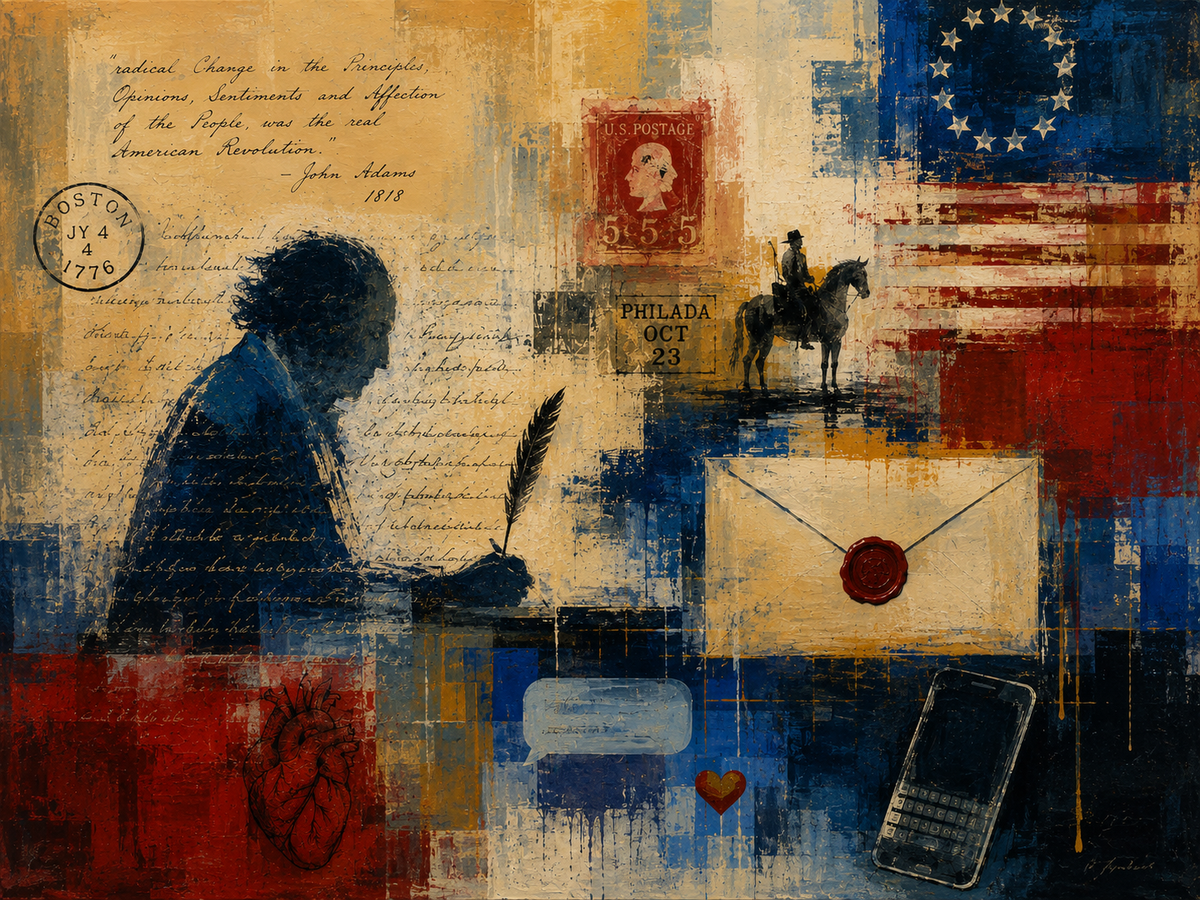
Writing in 1818 to the Quaker journalist Hezekiah Niles, John Adams – 17 years on from the end of his political career – reflected that the "radical Change in the Principles, Opinions, Sentiments and Affection of the People, was the real American Revolution." And how was this Change effected? How did a people who had always understood their grievances against Parliament as violations of their "rights as Englishmen" forge an entirely new identity as this new, made-up thing called "Americans"? In significant part, through pamphleteers and the flowering of the North American epistolary tradition.
To many, Benjamin Franklin's global legacy is as a diplomat, and understandably so. He is the only Founder to have signed the Declaration, the Treaty of Alliance with France, the Treaty of Paris, and the U.S. Constitution. But his efforts as Deputy Postmaster General (from 1753) to professionalize mail delivery require us, I think, to consider if Postmaster was not indeed the position in which America's favorite utility infielder had the highest Wins Above Replacement. He put riders on the roads at night to cut delivery times dramatically, introduced standardized rates based on weight and distance, created a dead-letter office, and connected the network to packet ships serving Canada and the West Indies.
By the time Thomas Paine published Common Sense (1776) decades of epistolary infrastructure had been laid. Now, those networks were infused with an ideology that would change the course of world history.
The last time I wrote a letter, as best I can remember, would have been in the summer of 2003. I was vacationing with my family in Southeast Ohio and missed my girlfriend. I probably had a Nokia phone at the time and may have even had the capacity to send text messages. But those of us who remember the T9 era know how difficult it would have been to communicate that way, to say nothing of being charged by the letter. I may not have actually ever ended up putting the letter in the mail. But it was helpful to me, in that moment, to express my thoughts and feelings in the form of a letter.
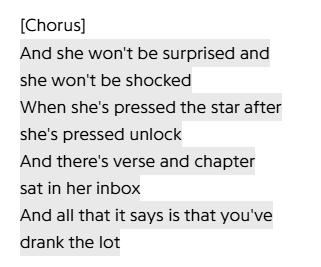
The hand-written letter, like any technology, is not a neutral medium. The watch has an ideology: no longer do we rise and fall with the sun but with the chime of the clock. As Neil Postman argued in his seminal Amusing Ourselves To Death (1985), the ideology of the television is show business; any narrative told through the television will necessarily be re-formatted into and experienced by the audience primarily as entertainment. Forty years later, we have a two-term reality-TV president with a cable news cabinet.
In the words of Postman's mentor, Marshall McLuhan, the medium is the message.
So, what is the ideology of the epistolary tradition? First and foremost, letters are usually written to someone in particular, whereas the blog or the Substack is intended for a mass audience. Sure, there has long been the open letter and the letter to the editor. Since there have been letters, some people writing have at least harbored the hope that they were writing for history as well as for themselves. But the vast majority of letters were only ever meant for an audience of one.
It stands to reason, therefore, that the content of a letter would be far more intimate and confessional than the content of a blog. And indeed this technology produced a generation of extremely sentimental people. The same correspondence networks through which the Founders exchanged ideas about government also functioned as "sympathy networks," in which people across long distances bared their souls to one another. The Power of Sympathy (1789) is widely regarded as the first American novel and features characters who experience emotions so intensely that they die as a result. I learned about this book in school and thought the plot was pretty silly; then last week I had to pull over on the side of the road and do breathing exercises because I'd gotten too worked up thinking about how moved I am that Harrison Ford has decided to throw himself so forcefully into spending three years playing a character with Parkinson's Disease.
It heartens me that Virginia Evans' debut novel The Correspondent has become one of the runaway successes of 2026. It is told entirely from the perspective of an elderly woman's private correspondence. Part of what makes the book so charming is the anachronism. That you have a woman so fiercely committed to preserving, at least in her own life, this antiquated form of communication. It's unlikely that Evans could have intended to draw out this parallel, but how fitting for The Correspondent to be released during the 250th anniversary of the Declaration of Independence?
It has never felt more necessary to rediscover the power of sympathy. I don't think we can get there by chastising people for lacking it, cathartic thought that may sometimes be. I think we need to wield the tools that draw these qualities out of us. One of these tools is the letter. Or, if not the letter precisely, some personal and confessional mode off address that leads to more sympathetic habits of mind. I want to live in a world, for instance, where more people take the side of the woman struggling with post-partum depression, not the multinational beauty company who fired her for struggling.
As you have surely noticed, I have been in a creative rut for quite a while. I tanked my journalism career by trying and failing to stand up for a friend who was being sexually harassed by her boss. (In fairness, my timing was poor. #MeToo hadn't quite hit yet. Better luck in my next life, I guess.) College football, the sport which had once been my muse, no longer exists in any meaningful way. The internet leaves me constantly exposed to writers who are far more talented than I could ever hope to be. So what would be the point in even trying? If the argument has been or will soon be made better, more persuasively, with more erudite references, by people who had the foresight to go to the right schools and get the right internships out of college?
But what if I was just talking to my brother? How might that change the way I write, to be communicating not with an indifferent comment section, or in the hopes that someone important might read it and offer me a job? What if I was talking to the only other person who remembers the way Grandpa smelled? What would that be like?
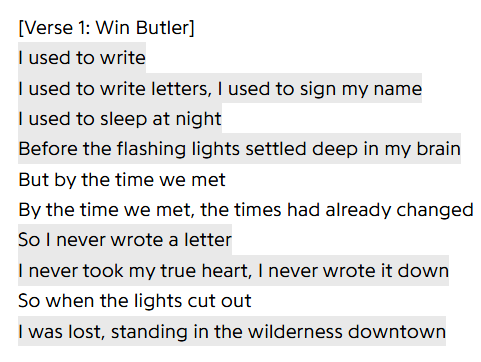
My life has not always been easy; sometimes because I've made it that way, sometimes because other people made it that way, sometimes because nature made it that way. My wife and my son have definitely helped smooth out many of my rough edges. But even before they came into the picture, there was Drew. When we all the world was in blur, when we were being shuttled from our mom's house to our dad's house to our dad's house to school to mom's new house to our new school to dad's new house, there was Drew. When we were being coached to tell the guardian ad litem to say this or not say that, there was Drew.
There have been times when he has made me furious and, no doubt, times when I returned the favor. But when I need someone to hear what I have to say and see me when I'm hiding, I call Drew.
Recently I had this idea that maybe I should tape up a picture of Drew's face above my computer. I don't think I'm literally going to do that. But I have done the next best thing: I've made him my editor in exchange for being his. I do not know why it took us 38 years to think of this.
But here we are.
This was initially supposed to be a brief preamble explaining why this post would be addressed to Drew. But, as you can see, it has now become arguably too long already. So I guess I'll save the thing I really wanted to talk about for next time.
Yr. Obt. Svt.,
Connor